Compare 5w-30 Motor Oils
ASTM comparison tests using Amsoil Signature Series
5w-30 motor oil against Mobil 1, Castrol Edge® with Titanium Fluid Strength Technology®, Lucas Synthetic,
Mobil 1™ Extended Performance, Pennzoil Ultra™, Petro-Canada SUPREME Synthetic™, Quaker State Ultimate Durability™,
Red Line High Performance Motor Oil, Royal Purple High Performance Motor Oil, Valvoline SynPower® Full Synthetic
Motor Oil.
Below we Compare the performance in laboratory tests and cost-effectiveness of AMSOIL Signature Series
5w-30 Synthetic Motor Oil to several passenger-car/light-truck synthetic motor oils including
Castrol Edge® with Titanium Fluid Strength Technology® Lucas Synthetic Mobil 1™ Extended Performance Pennzoil
Ultra™ Petro-Canada SUPREME Synthetic™ Quaker State Ultimate Durability™ Red Line High Performance Motor Oil
Royal Purple High Performance Motor Oil Valvoline SynPower® Full Synthetic Motor Oil widely considered by
marketers and consumers to be the best available.
Laboratory bench testing conducted in accordance with American Society of Testing and
Materials (ASTM) procedures examined several important areas of motor oil performance, including resistance to
deposit formation, wear protection, high-temperature stability, resistance to acid formation and cold-temperature
performance. Bench tests are used widely to differentiate between formulations.
While conventional motor oil sales remain flat, synthetic motor oils continue to demonstrate strong annual growth.
Motorists now recognize that synthetics legitimately improve engine performance, particularly in engines that
operate under severe service. Performance cars and many traditional family vehicles today leave the factory with
synthetic oil installed and recommended as the service fill, contributing to synthetics’ increased demand. Oil
manufacturers have responded. Many now formulate multiple synthetic motor oils, often led by a flagship product
that represents each company’s most advanced technology.
Note: Test results published in this Technical Study describe and represent
properties of oils that were acquired on the dates listed in Table 1 (page 3). Results do not apply to any
subsequent reformulations of such oils or to new oils introduced after completion of testing. All oils were
available to consumers at the time of purchase. Testing was completed February 2013 by an independent, third-party
lab. Formulations were coded to eliminate bias, and samples were tested in random order. An appropriate number of
trials of each oil were run to produce results at the 95 percent confidence level when compared to Signature Series
Synthetic Motor Oil.
ASTM Tests
Performed
Each oil was subjected to the following ASTM test methodologies:
• Four-Ball Wear Test (ASTM D 4172 Mod.)
• Total Base Number (ASTM D 2896)
• Cold Cranking Viscosity (ASTM D 5293)
• Thermo-Oxidation Engine Oil Simulation Test (TEOST, ASTM D 6335)
• NOACK Volatility Test (ASTM D 5800)
Candidate
Oils
The following 10 synthetic motor oils were selected. All oils were 5W-30 and are recommended for the
American Petroleum Institute (API) SN and International Lubricants Standardization and Approval Committee
(ILSAC) GF-5 performance specifications
| Motor Oil |
Aquired
|
Batch Code |
API/ILSAC Specification
|
AMSOIL Signature Series
Synthetic Motor Oil |
Nov. 2012 |
15455 298 |
SN/GF-5 |
Castrol Edge with Titanium Fluid
Strength Technology |
Dec. 2012 |
A1229220921 H1 |
SN/GF-5 |
| Lucas Synthetic |
Nov. 2012 |
12206 I512:33 |
SN/GF-5 |
| Mobil 1 Extended Performance |
Dec. 2012 |
11012L04A 15 5888 |
SN/GF-5 |
| Pennzoil Ultra |
Dec. 2012 |
10413471 U001 22MAR12 0701 1 |
SN/GF-5 |
| Petro-Canada SUPREME Synthetic |
Dec.2012 |
121019LX 011137 122163*
121019LX 011154 122163*
121019LX 011186 122163* |
SN/GF-5 |
| Quaker State Ultimate Durability |
Dec. 2012 |
10492378 U002-111OCT12
15:13
|
SN/GF-5 |
|
Red Line High Performance
Motor Oil
|
Dec. 2012 |
62286 9343P-003442 |
SN/GF-5 |
|
Royal Purple High Performance
Motor Oil
|
Dec. 2012 |
ICPR33A18201 |
SN/GF-5 |
|
Valvoline SynPower Full
Synthetic Motor Oil
|
Dec. 2012 |
J2212C5 1949 |
SN/GF-5 |
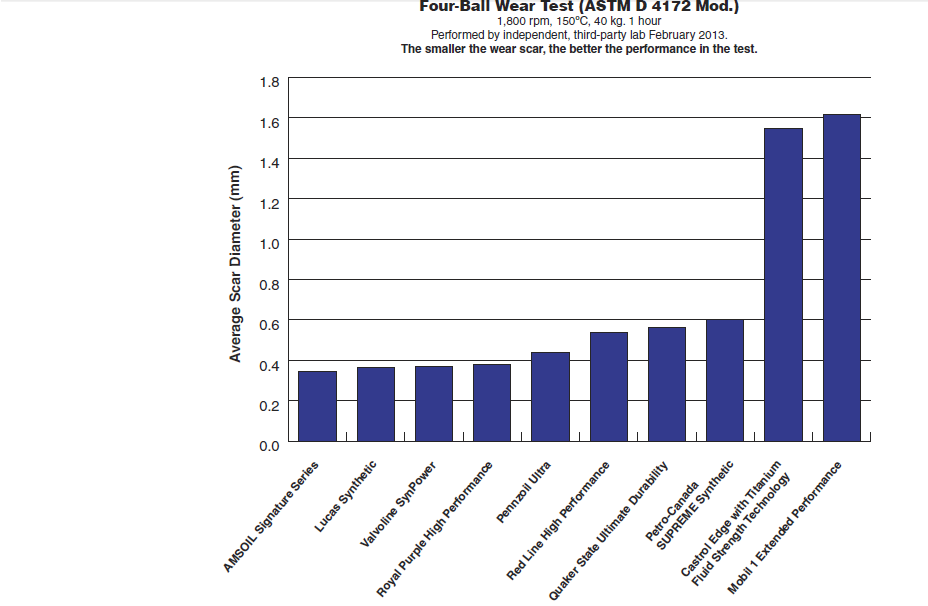
Four-Ball Wear Test (ASTM D
4172 Mod.)
According to the ASTM, the Four-Ball Wear Test “can be used to determine the
relative wear preventive properties of lubricating fluids in sliding contact under the prescribed test conditions.
No attempt has been made to correlate this test with balls in rolling contact. The user of this test method should
determine to his own satisfaction whether results of this test procedure correlate with field performance or other
bench test machines.”
Although not widely used as an engine oil test, the Four-Ball Wear Test provides a means of comparing relative
wear-protection properties of lubricating oils. To better differentiate between lubricants, the severity of the
test was increased with higher rpm and temperature (the test standard allows for running the test under modified
parameters). The size of the scar as a result of the test indicates the level of wear protection the lubricant
provides.
Results
Four-Ball Wear
Test results indicate significant differences in relative wear protection between oils. The top four performers
limited wear scars to under 0.40 mm. AMSOIL Signature Series Synthetic Motor Oil demonstrated the best wear
protection in the Four-Ball Wear Test.

Total Base Number (ASTM D
2896)
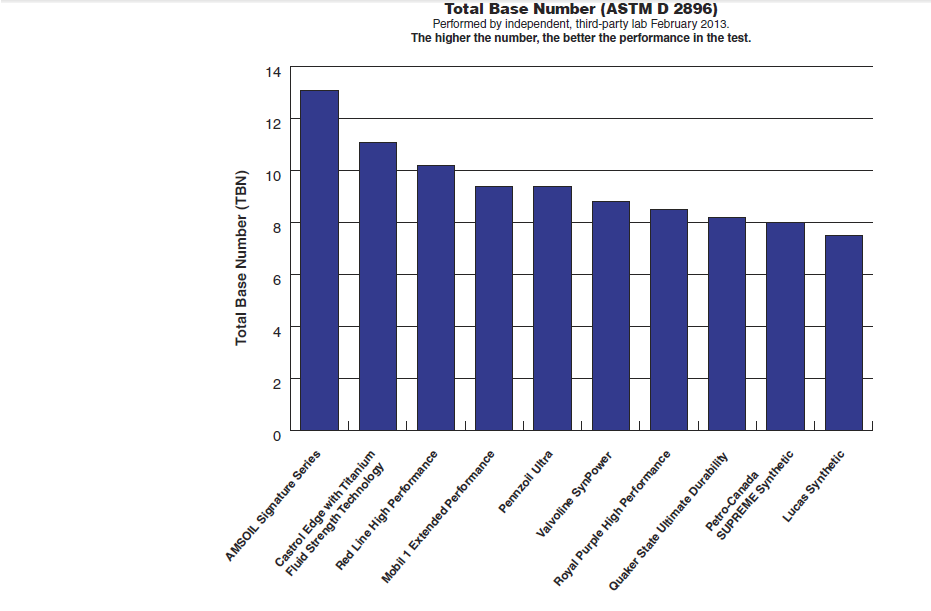
Total Base Number (TBN) is the measure of a lubricant’s reserve alkalinity,
which aids in the control of acids formed during the combustion process. TBN can also be used as a measure of
lubricant degradation in service. Motor oils that have a high TBN and demonstrate good TBN retention are known
to effectively reduce the corrosive effects of acids over an extended period.
Results
AMSOIL Signature Series Synthetic Motor Oil tested two numbers
higher than the nearest competitor.
Cold Cranking Viscosity (ASTM D
5293)
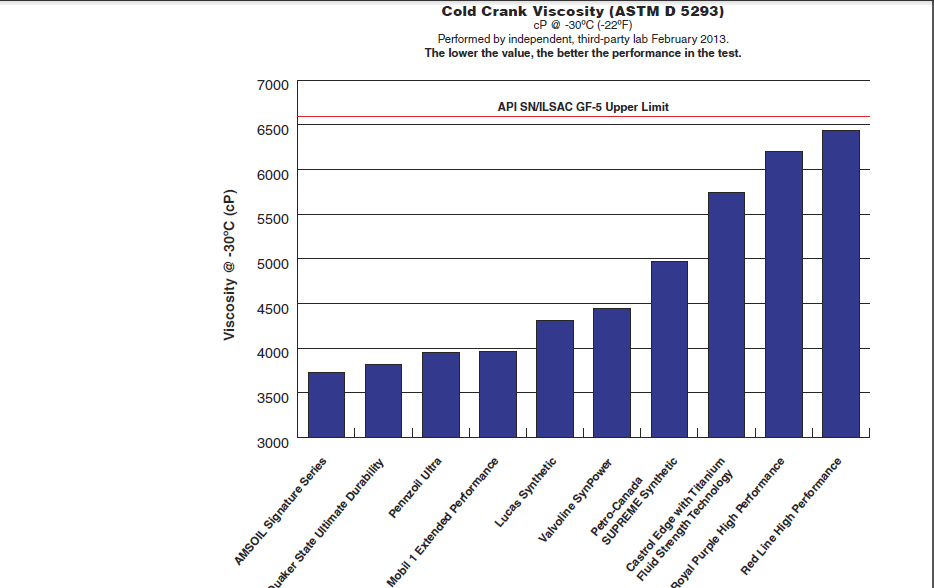
The Cold Crank Simulator Test determines the apparent viscosity of lubricants at
low temperatures and high shear rates. Viscosity of lubricants under these conditions is directly related to
low-temperature engine cranking. The test was performed at -30ºC (-22ºF). Results are reported in centipoise (cP),
with lower values reflecting easier cold starts and reduced battery strain. To meet the API SN and ILSAC GF-5 motor
oil specifications, a motor oil’s cold crank viscosity must not exceed 6,600 cP.
Results
Although synthetic
motor oils are known to provide increased low-temperature performance compared to conventional oils, results
suggest performance differences between formulations. AMSOIL Signature Series Synthetic Motor Oil demonstrated the
lowest cold-crank viscosity (3,727 cP).
Thermo-Oxidation Engine Oil
Simulation Test (TEOST, ASTM D 6335)
Motor oils can form deposits when exposed to
increased heat, reducing efficiency and contributing to poor overall performance. According to the ASTM, the TEOST
test method “is designed to predict the high temperature deposit forming tendencies of an engine oil. This test
method can be used to screen oil samples or as a quality assurance tool.” Given the number of vehicles now equipped
with direct fuel injection, turbochargers and other performance-enhancing technologies that increase heat, deposit
control has taken on increased importance. To meet the API SN Resource Conserving and ILSAC GF-5 motor oil
specifications, a 5W-30 motor oil must limit total deposit formation to 30 mg or less.
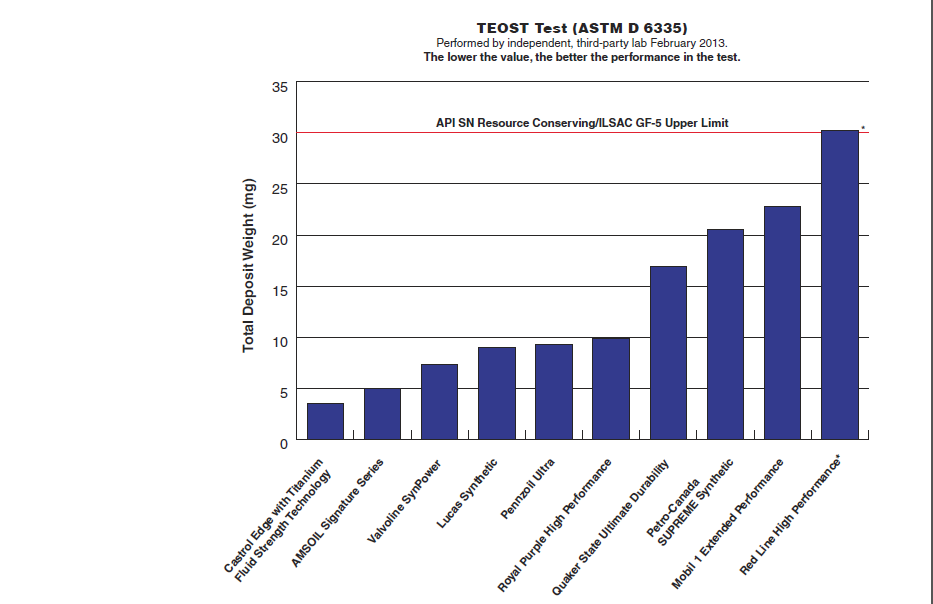
*Results for Red Line High Performance ranged from 29.1 mg to 31.4 mg. The average of the three tests run is
shown in the graph.
Results
Results
demonstrate a range of performance differences between oils. Only Castrol Edge with Titanium Fluid Strength
Technology and AMSOIL Signature Series Synthetic Motor Oil limited total deposit weight to 5 mg or less.
NOACK Volatility Test (ASTM D
5800)
The NOACK Volatility Test determines the evaporation loss of lubricants in
high-temperature service. According to the ASTM, “Evaporation may contribute to oil consumption in an engine and
can lead to a change in the properties of an oil.”1 As with the TEOST test, low values in the NOACK Volatility Test
are of particular benefit in modern, hot-running engines.
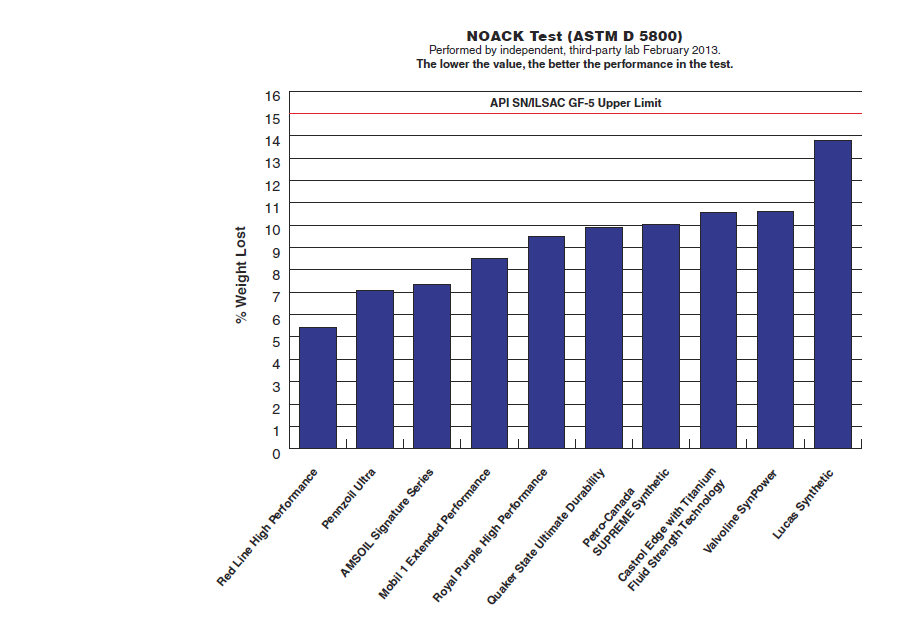
In the NOACK test, a candidate oil is exposed to heat and circulating air. Following 60 minutes, the remaining
oil volume is weighed and compared to the original weight, with the difference reported as the percentage of weight
lost. Results must be limited to 15 percent or less to meet the API SN and ILSAC GF-5 specifications.
Results
While all oils
were below the API SN and ILSAC GF-5 upper limit, results indicate differences in hightemperature volatility. Half
of the oils limited the percentage weight lost from volatility to under 10 percent, with AMSOIL Signature Series
Synthetic Motor Oil having the third-best result.
Overall Annual
Cost
Although AMSOIL Signature Series Synthetic Motor Oil is recommended for 25,000
miles/one year in normal service1, light-duty vehicles accumulate an average of 11,318 miles a year2 and are
generally used in driving conditions that fall under the severe service3 category. For those reasons, overall
annual cost is evaluated at 11,318 miles under severe service driving conditions. Signature Series Synthetic Motor
Oil carries a drain interval of up to 15,000 miles/one year, whichever comes first, in severe service. Because the
other nine oils do not carry a recommended drain interval, a drain interval of 4,777 miles was used, which
represents the average drain interval of motorists as reported in the 2012 National Oil & Lube News Operator’s
Survey. Although Mobil 1 Extended Performance is recommended for 15,000 miles in out-of-warranty vehicles in
certain driving conditions, its extended drain recommendation does not apply for this evaluation. According to the
official statement on the Mobil 1 Extended Performance label, “Extended service is not recommended in severe
service applications involving racing and commercial use, frequent towing or hauling, extremely dusty or dirty
conditions, or excessive idling.”
Per-quart prices (Table reflect the MSRP where available or average of a cross-section of retail
outlets
surveyed January 2013. Costs are based on a five-quart capacity. Overall value represents the cost of the oil
only.

1 AMSOIL defines normal service as personal vehicles frequently traveling greater than 10 miles at a time and
not operating under severe service.
2 “Average Vehicle Distance Traveled in Miles and Related Data – 2011 (1) By Highway Category and Vehicle
Type”.
http://www.fhwa.dot.gov/policyinformation/statistics/2011/pdf/vm1.pdf.
3 AMSOIL defines gasoline engine severe service as turbo/supercharged engines; commercial or fleet vehicles;
excessive idling; daily short-trip driving less than 10 miles (16km); frequent towing, plowing or hauling;
dusty-driving conditions; or in vehicles with 100,000 or more miles that will be using AMSOIL engine oil for the
first time.
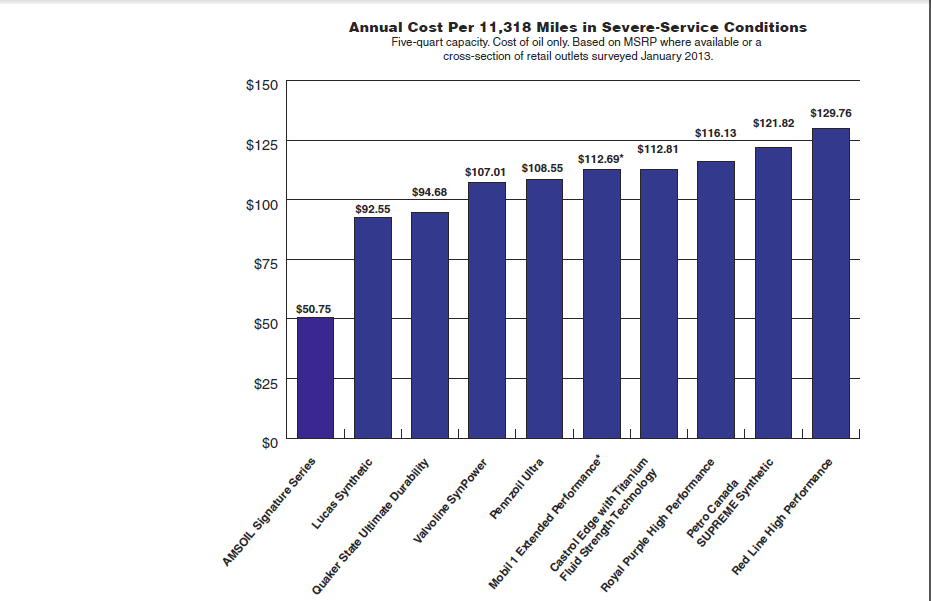
*Not recommend for extended service in vehicles used in severe-service driving conditions. See official
statement on the Mobil 1 Extended Performance label.
Results
Though the retail
price per quart of AMSOIL Signature Series Synthetic Motor Oil is initially higher, it provides lower costs
compared to the other oils. Overall, Signature Series is the most cost-effective oil.
Conclusion
AMSOIL Signature Series Synthetic Motor Oil ranked
first in four of the six comparisons. In contrast, while some oils performed well in a few areas, they did
not perform as well in others. Different results from one test to another indicate an emphasis in one area of
performance does not correspond to increased performance in other areas of testing. It also reveals the
difficulty inherent in formulating a high-quality motor oil that performs well in tests designed to assess
optimum engine protection and life. As engines continue to evolve and demand more from motor oil, the need
for premium lubrication becomes more critical. Industry-standard testing performed by an independent,
third-party laboratory reveals AMSOIL Signature Series Synthetic Motor Oil to be the overall top-performing
oil in these tests. When considering the savings of time and money available due to its 15,000-mile/one-year
drain interval in severe service, Signature Series is also the most economical choice.
Royal Purple Info
As you may know,
Royal Purple is well known in racing circles. The chemistry they use is something AMSOIL, Inc. chooses not to
use in their oil formulation. One of Amsoil's big selling points is extended drain intervals, such as our
25,000 mile and 35,000 mile oil change intervals. Some additive chemicals such as Moly may cause adverse
conditions when used for long periods.
Royal Purple uses
a different chemistry than most oil producers. They are one of only a handful of marketers using Molybdenum
Disulfide (Moly) in their oil formulations at
these higher levels.
Moly is a
processed mineral that is similar in appearance to graphite. Moly has good lubricating properties when used
either by itself (in dry power form or as an additive to oil or other lubricants). Particles of the Moly can
come out of suspension and agglomerate. Over time this may actually clog or partially clog oil filters or oil
lines and the remainder normally settles in the bottom of the oil pan. This seems to be more likely when
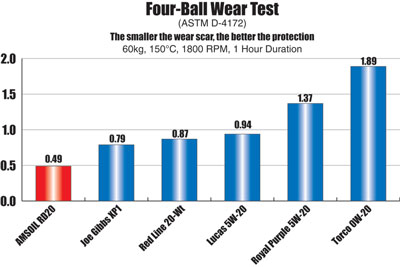
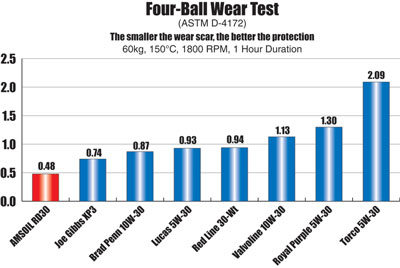
using extended drain intervals. The only test we ran on Royal Purple involved their 20W50 Racing oil versus our
AMSOIL Series 2000 Synthetic 20W50 Racing Oil (TRO). We ran two 4 ball wear tests with different
parameters, a spectrographic baseline, FTIR scan and volatility tests. The Royal Purple showed a
significantly high volatility rate with a 12.51% boil off rate. This compares to the AMSOIL TRO with only a
4.47% volatility rating. Wear scars were also smaller with the TRO. For example the AMSOIL TRO left a
.41mm scar and the Royal Purple oil left a .66mm scar. The lower the scar damage number the better!
There was also a surprising difference in the viscosity index. The RP has a VI of 129 versus 155 for
the TRO. The higher the VI, the better the viscosity stays in place at high temperatures.
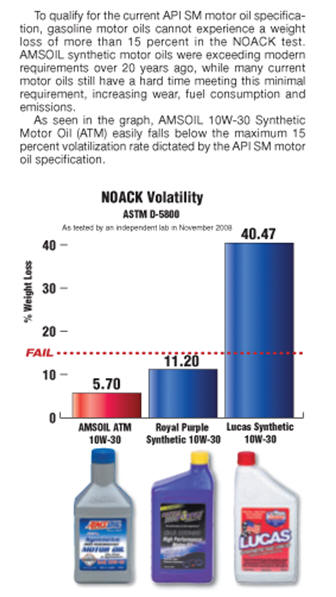
Note: This
information was provided by AMSOIL, Inc. Tech Department. An independent lab tested the Royal Purple 20W-50
racing oil against the AMSOIL 20W-50 racing oil. The results are posted above. Test results found Moly in the
Royal Purple oil sample.

Amsoil Preferred Customers get wholesale prices

A AMSOIL Preferred Customers and Amsoil Dealers are able to purchase at wholesale cost. A preferred
customer doesn't have the responsibilities of owning a Dealership.
Why are we offering this 6 month Trial Membership? We believe any AMSOIL user can benefit by becoming a
Preferred Customer (PC). As a PC you can buy AMSOIL lubricants at wholesale prices (the same prices AMSOIL Dealers
pay) and have AMSOIL shipped direct to your home or business. Furthermore, when you sign up using this form, we
will be able to assist you in the proper selection of lubricants and filtration products for your application.
Thanks in advance for registering.
If you would like to contact us or have questions or feedback about our products and
services, please send your request using the form below. Feel free to call with your
questions.
The information you place on this form will never be sold
or used in a manner other than this preferred customer program submission form and to send the
information to you.
It's quick and easy to register. Click the link to register as a AMSOIL Preferred Customer 6
month trial membership.
NO OBLIGATION TO RENEW and YOUR MEMBERSHIP WILL NOT RENEW
AUTOMATICALLY!!
IT'S ALL IN YOUR CONTROL AFTER THE TRIAL PERIOD IS
OVER.
Amsoil PC & Dealership Information Request form
|